


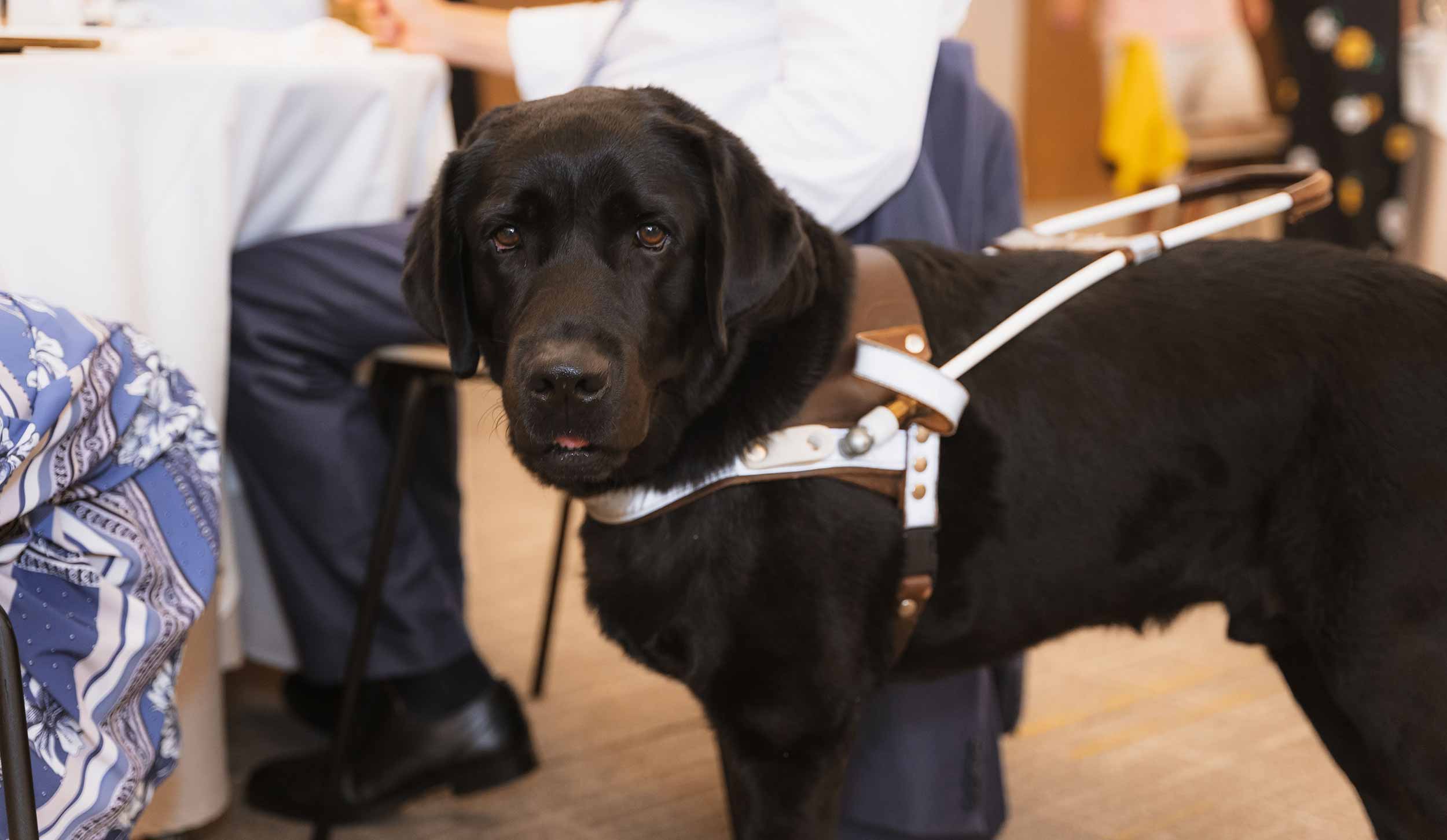
Somewhere in Bedfordshire, a golden retriever-Labrador cross called Bramble is doing something no wearable, no app and no alarm clock can quite manage.
He is watching a person for a living.
Not guarding her. Not fetching for her. Watching. Reading. Sniffing the air around her like it is the morning paper.
His job is Sarah. Just Sarah. Not people in general - one specific human, whose body he knows better than most doctors ever could.
And when Sarah's blood sugar starts to slide, Bramble knows. Often before Sarah does.
The way she tells it, he has saved her life more times than she can count. And then the line that stays with you: she doesn't lie awake anymore wondering whether she will wake up.
That last part is the whole article, really. A dog that lets a person sleep.
One dog. One person. One nose.
Here is the clever bit, and it isn't what people assume.
Bramble isn't sniffing the world for "illness" in general. He has learned one person's normal. Sarah's baseline. Her ordinary, everyday, slightly boring human smell.
Because every person is a moving cloud of information. Breath, sweat, hormones, stress, sleep, food, medication - all of it leaves tiny chemical traces. Scientists call them volatile organic compounds, which sounds like something a Bond villain releases into a volcano lair, but really just means the smells your body gives off without asking your permission.
Humans are hopeless at reading them. Dogs are not.
When Sarah's blood sugar drops, her chemistry shifts and the smell changes. Bramble notices, and refuses to be ignored - a nudge, a paw, a stare that says sit down, test, now.
Think of it as a smoke alarm for your own body. Except this one wants biscuits, sheds on the sofa, and occasionally sits on your foot.
But is it really work?
Here is where it gets interesting, and where we would like to pick a small, friendly fight.
To Bramble, none of this is work.
He isn't thinking, "Ah yes, a medically significant drop in glucose." He is thinking, in dog: Sarah smells wrong, this is the part where I boop her. He would do it for free. He does do it for free. Nobody has ever successfully explained "a job" to a Labrador.
That is the strange truth underneath every working dog: to the dog, it isn't work at all. It is just the thing they love, done at full volume.
It only becomes a job the moment a human gets something out of it.
And here, the human gets a lot. Sarah gets to sleep. She gets to go out. She gets to stop living braced for an emergency that Bramble will now spot first. That isn't sentiment - it is independence. And independence has a value you can nearly put a number on: fewer ambulances, fewer hospital nights, a life that doesn't shrink to fit an illness.
Bramble will never see a payslip. He is paid in dinner, walks, praise and the occasional stolen sausage. But make no mistake - he is working.
Not magic. Just annoyingly good.
There is a trap with stories like this. People either roll their eyes - dogs can't smell illness, don't be daft - or they sprint the other way and start treating dogs like tiny four-legged wizards.
They are neither. They are trained animals with extraordinary noses, a deep habit of watching humans, and a talent for spotting patterns we miss. A dog living beside you notices the things you don't advertise: a change in your breathing, a new stillness, a smell you didn't know you had.
We tend to only call something "intelligent" when it looks like our kind of intelligence - maths, language, sitting still in a classroom pretending not to be bored. Dogs are clever in a different key. They read bodies. They read rooms. They read the chemical weather.
A teenager might call it "vibes". A dog, if it could talk, would say: your cortisol has entered the chat.
Same skill. Better nose.
What the dog is really telling us
Medical alert dogs aren't a miracle, and they don't replace the serious kit - blood tests, continuous glucose monitors, actual doctors. Accuracy varies. Dogs have off days. Nobody should stake a life on a nose alone, and the good charities are the first to say so.
But they point at something genuinely important. The body talks before the crisis. It leaves chemical clues, minutes or hours ahead, that we are simply too blunt-nosed to read. The dog reads them.
And that is where Britain's whole medical-detection story begins - not in a laboratory, but on a sofa, with a dog that wouldn't stop nudging. In 2009, a Labrador called Daisy kept pawing at her owner's chest until the owner got it checked. It was an early breast cancer, caught in time. That owner, Dr Claire Guest, went on to found the charity Medical Detection Dogs. The living-room alert dog and the laboratory science dog turn out to be two ends of the same nose.
Somewhere tonight, a person with a dangerous condition is going to fall asleep without fear. Because a dog they never put on a payroll - who doesn't know what diabetes is, who mostly wants dinner and a walk - is lying by the bed doing the one job it was born to love.
Listening. Or rather, smelling. Mostly smelling.