

In November 1944, during the assault on Walcheren, a landing craft went over in cold water under shellfire. Lance Corporal Muldoon could not swim. His dog could.
Khan had been a family pet in Tolworth, Surrey, lent to the War Office two years earlier because the army had asked the public for dogs and the Railton family had one to give. He had known Muldoon a matter of months. He went into the water, found him, and pulled him to the bank.
The army gave the dog a rank and called him Rifleman Khan. Britain gave him the Dickin Medal, which is as close as an animal gets to the Victoria Cross.
Here is the thing worth sitting with. Nobody trained Khan to do that.
What the army actually hires a dog for
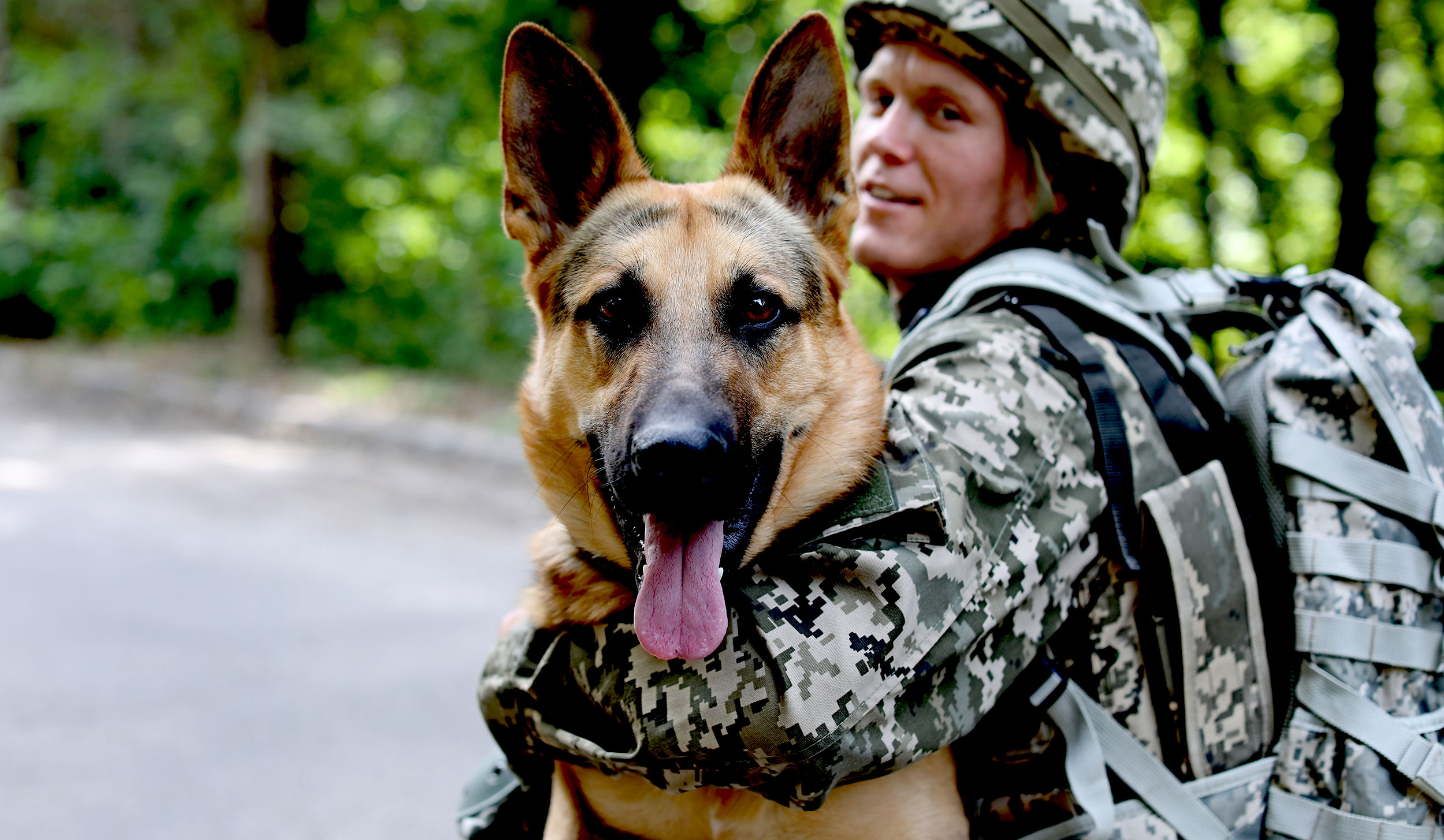
Military working dogs are not weapons, whatever the films suggest. They are sensors with legs, and almost all of the work is detection.
An arms and explosives search dog walks a route ahead of the people who would otherwise walk it. It is looking for a smell: the chemistry of an explosive, of a weapon that has been handled, of a cache buried under a track. When it finds one it does not attack anything. It sits down, or lies down, and waits to be paid.
That is the whole job, and it is worth being precise about why it matters. A dog working a route is not finding bombs. It is finding them before a person does. The value is entirely in the gap between those two sentences.
The rest of the work is the same skill pointed at different problems: patrol dogs that notice somebody who should not be there, tracking dogs that follow a person across ground, casualty dogs that find the wounded, and in the Second World War, rescue dogs that worked British streets after a raid.
Irma, and the thing she could do
Crumstone Irma was an Alsatian who served with London's Civil Defence during the Blitz, and she is credited with helping rescue 191 people from bombed buildings.
The figure is not the interesting part. This is: Irma could tell, by scent, whether the person buried under the rubble was still alive. Her handler learned to read the difference in how she reported it, and the rescue parties dug accordingly.
Think about what that means practically. In a street of collapsed houses, with hours of digging available and not enough of them, a dog was deciding where the effort went. It is the same faculty a medical detection dog uses on a sample tray, doing triage in the dark.
Irma did not know any of that. She was finding a smell and telling a person about it, which is the only job she thought she had.
Why the dog does it at all
A dog will not cross a minefield for a country. It has no view on the war.
It will do it for a ball, a tug toy and a handler. That is the real mechanism, and it is not a cynical reading: the search is a game with a prize, and the prize is not the explosive but the toy that comes after, and the person who produces the toy.
Which is why the handler-dog pairing is treated as a unit rather than a man and his equipment. The dog works for that person, reads that person, and in Khan's case will go into cold water for that person, because the relationship is what the work runs on.
It also means the dog cannot tell the difference between a training run and a real one. There is no version of the job where the dog understands the risk it is taking. It understands that its person is here, that the game is on, and that something is wrong when its person is frightened.
The breed that keeps turning up
Look down the list of dogs given the Dickin Medal and one breed appears more than any other: the German Shepherd, or the Alsatian as Britain called it for most of the last century.
Eight of them have received it. Jet of Iada and Crumstone Irma for the Blitz rescues, Thorn and Rex for finding casualties inside burning buildings, Khan for Walcheren, Brian who parachuted with the airborne, Antis who served with a Czech airman in the French Air Force and the RAF, and Appollo, the first search dog into Ground Zero.
That is not a coincidence of fashion. It is a breed built in the 1890s for exactly this: a working shepherd's dog selected for nose, stamina, biddability and a strong attachment to one handler. The breed's own training profile still says it bonds deeply with one person, which is an asset in a job where the dog has to want to come back.
The same paperwork has a second column, and it reads: needs firm, consistent handling, and can develop anxiety.
What the job costs
A military dog does not get to decide that it has had enough.
The physical price is the easy part to picture: the injuries, the worn joints, the broken teeth, the working life that ends years before the dog does. The rest is less visible. Dogs coming back from deployments have been diagnosed with a condition that looks very much like post-traumatic stress: a dog that will not enter a building, or will not work a vehicle, or attaches itself to one person and refuses to be handed on.
And there is the part nobody writes citations for. A dog that has spent its adult life with one handler, in a job that the two of them did together, does not understand a posting, a discharge, or a funeral. It understands that the person stopped coming.
We are good at counting the finds, the routes cleared and the lives not lost. We are worse at counting that.
And this, of course, is a job
Khan went back to Tolworth after the war, to the family who had lent him. Muldoon, the man he pulled out of the water, travelled to a parade in 1947 to handle him one more time, and the family gave the dog to him. That is the ending the story deserved, and it is the exception rather than the rule.
The modern position is better than it was. Retired military working dogs in Britain are routinely rehomed, usually with their handlers, and charities cover a good deal of the veterinary cost that follows. Better is not the same as settled: a dog with a decade of working injuries is an expensive animal to keep well, and the bill arrives after the usefulness has ended.
None of which the dog is aware of. It went where its person went, found what it was asked to find, sat down beside it and waited to be told it was good.
That is work. It has a payslip, whether or not anyone ever ran the numbers.