

Saxons 'n' Normans
For six hundred years Britain belonged to whoever had just arrived. The Romans came in AD 43 and left in 410. Then Anglo-Saxon kingdoms filled the map, Viking raiders took the north and east until Alfred stopped them in 878, and in 1066 the Normans took the lot. Every wave brought its own dogs, and Britain kept the best of each.
Who Owns Britain?
For six hundred years the island belonged to whoever had just arrived. Press play and watch the Britons get pushed west.
The Britons hold the whole island. Their families have been here since about 2450 BC, and so have their dogs.
- Britons
- Romans
- Saxons
- Danelaw
- Normans
Simplified map. These borders moved every few years and were never drawn as lines, so the shapes show roughly who held what, not exact frontiers.
How We Drew Britain
Nobody living here knew what Britain looked like. It took over a thousand years to get the shape right.
about AD 150
The Romans mapped Britain from reports and rough measurements, and Scotland came out bent east at a right angle. Nobody corrected it for over a thousand years.
- As they drew it
- The real shape
Impressions, not copies. Each outline is Britain's real coastline put through the mistake that map made, so you can see the error rather than the document.
Did you know?
One raid started it all (793)
Vikings attacked the monastery at Lindisfarne, off the Northumbrian coast, and the raids went on for years.
By 865 the raiding had turned into an invasion: the Great Heathen Army landed and took East Anglia, Northumbria and much of Mercia.
Half of England under Danish law
After Alfred beat Guthrum in 878, the two sides drew a line from the Thames up to Bedford and on towards Chester.
Everything north and east of it was the Danelaw, run from five Danish towns: Leicester, Nottingham, Derby, Stamford and Lincoln.
You can still hear them
Town names ending in -by, like Grimsby, Derby and Whitby, are Old Norse for a farm or village.
So is -thorpe, meaning a smaller settlement. Look at a map of Yorkshire and Lincolnshire and you are looking at where the Vikings settled.
Saxon and Norman Dogs
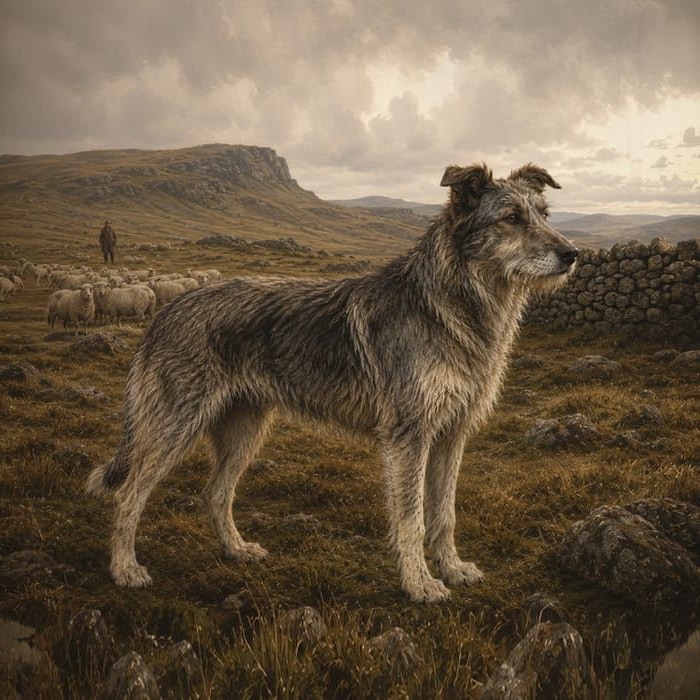
Between the Romans leaving and the Normans arriving, Britain was settled again and again. Saxon farmers, Norse settlers and Norman lords all brought dogs, and the dogs did what the new owners needed: herding, guarding, driving stock to market and hunting.
Dogs in these centuries were valued by what they could do, not by how they looked. A farm dog that moved cattle, a watchdog that barked at strangers and a hound that could follow a trail were worth real money, and the law said so. After 1066 the Norman kings made hunting a royal privilege, which turned some dogs into prized possessions and left others on the wrong side of the forest laws.
- Saxon farms kept sturdy herding and guard dogs, the stock behind Britain's later collies.
- Norse settlers brought their own working dogs into the north and east.
- Norman lords brought hunting hounds and the laws that reserved the deer for themselves.
- The scent hound rises: the Talbot and the Rache are named in this period.